Pre-Sale Buyer: Why Are You an Unsecured Lender?
In Mexico pre-sales, buyers pay upfront but hold only a promise—making them unsecured lenders if projects fail. Banks get paid first. Legal safeguards (escrow, collateral, audits) reduce risk.
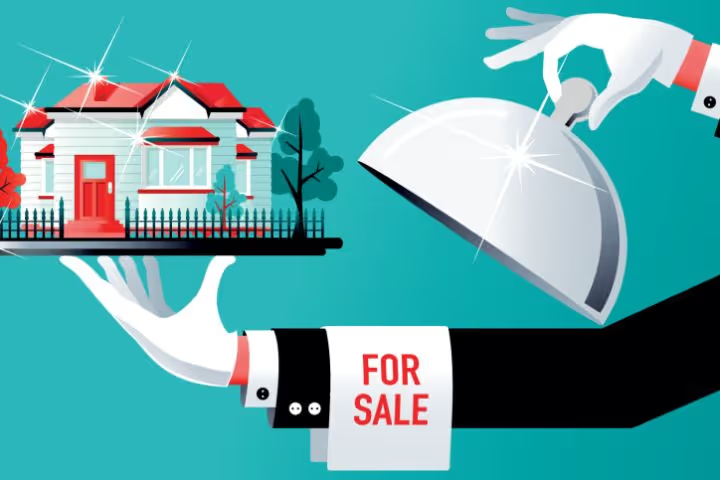
In Mexico’s real estate pre-sale market, buyers typically sign a promise-to-purchase and sale agreement and begin paying a down payment plus monthly installments for months or even years. In return, they receive only a promise that the developer will deliver the property in the future.
Meanwhile, the developer can secure a bridge loan from a bank by pledging the land or the project as real mortgage collateral. The result is a profound imbalance: the buyer becomes an unsecured lender, while the bank is a privileged creditor with priority rights.
What does it mean to be an unsecured Lender?
Legally, an unsecured lender holds only a personal right (a contractual claim), not a real right over the property itself.
If the developer:
- Files for bankruptcy
- Stops construction
- Disappears, or
- Simply fails to meet deadlines
The bank can foreclose on its mortgage and take the land or the unfinished project.
Buyers are left at the very end of the line in bankruptcy proceedings or judicial foreclosure.
In practice, recovering the money paid (down payment + installments) is extremely difficult and expensive. Many buyers end up in lengthy lawsuits, without a property, and with losses in the millions.
The clearest example: Tulum
Between 2023 and 2025, more than 70 pre-sale projects in Tulum were never delivered.
According to reports from Bloomberg, El Financiero, and Expediente Quintana Roo:
- Hundreds of buyers (many foreigners) lost their entire savings.
- Developers vanished, construction halted, and prices fell as much as 47.6%.
- In several cases, buyers sued for breach of contract, but developers countersued for “non-payment” or simply declared bankruptcy.
The bank, with its mortgage on the land, recovered first. Buyers, holding only a promise of sale, remained unsecured creditors with no priority.
Why do standard contracts leave you in this position?
Most developers use adhesion contracts that:
- Do not grant the buyer any real collateral (no mortgage, no guarantee trust).
- Do not tie payments to certified construction progress.
- Include clauses that release the developer from liability in cases of “force majeure” or “financial difficulties.”
- Do not provide real, enforceable mechanisms for refunds in the event of serious breach.
While the buyer is obligated to pay on time and in full, the developer assumes no strict deadlines or enforceable guarantees.
How to stop being an unsecured Lender:
A specialized real estate attorney can completely transform your contractual position by requiring:
- Real collateral → A guarantee trust (fideicomiso de garantía) or mortgage in favor of the buyers (or a common representative).
- Escrow → All payments are held by an independent Escrow Agent and released only against certified construction progress verified by an independent expert.
- Conditioned payments → Installments tied to progress certificates, not to a fixed calendar.
- Real and enforceable penalties → Full refunds with high interest and automatic contract termination in case of default.
- Developer due diligence → Review of credit history, prior lawsuits, and financial capacity.
Title Solutions de México: Protection from the very first payment
We anticipate risks by:
- Conducting exhaustive audits of the project, permits, and titles.
- Drafting and negotiating balanced contracts that include real guarantees and payments conditioned on progress.
- Implementing escrow to safeguard every peso you pay.
- Providing full accompaniment throughout the pre-sale process and up to the final deed.
In a market where banks always have real collateral, and buyers normally do not, the only way to balance the scales is with specialized legal advice from day one.
Do not sign a promise to purchase and sale that turns you into an unsecured lender.
Turn your investment into a protected real right. If you are considering a pre-sale, contact us before making the first payment.
Your patrimony deserves to be at the front of the line — not the back.
